.jpg)

.png)
Introduction
Over the past decade, the United States has experienced disconcerting indicators signaling the corrosion of our democratic culture. Political risks, including the attempted overturning of the 2020 election results, efforts to restrict voting rights, the seemingly boundless growth of political spending, and the politicization of the judicial branch, point to the precarity of American democracy. At this time, we believe there is an opportunity and responsibility to defend and reinforce democratic principles and structures to guard against current and further risks.
Financial Times journalist Martin Wolf argues that capitalism and democracy are mutually reinforcing, and neither can survive and thrive without the other. In his book "The Crisis of Democratic Capitalism," Wolf believes the failed task of solving obscene income inequality and a lack of upward economic mobility has stoked the current political polarization and dysfunction of democracy in the U.S. and Europe.
For any investor participating in the capital markets, supporting democracy should be a top priority to enable the efficiency and stability of the investment landscape.
In this brief, we discuss the business and economic case for democracy, share examples of our advocacy efforts to strengthen civil engagement, and offer a framework for evaluating corporate support for democratic principles.
Building the Case for Democracy Through an Economic and Business Lens
At Trillium Asset Management, LLC (Trillium), we uphold the conviction that a robust democracy is the cornerstone of a flourishing society where freedom, equality, and justice are not just ideals, but realities. A liberal democracy is fundamentally valuable to Trillium as the linchpin of holding a government accountable to its people and protecting their rights.
However, there is also economic and business-related value of American democracy. Such governance is essential for maintaining the rule of law, upholding contractual obligations, nurturing competitive fairness, dispensing justice, safeguarding human rights, and combating fraud and deception — the pillars that help ensure an equitable and flourishing economic landscape.
From both a broader societal and ethical standpoint, as well as from a focused business perspective, there are compelling reasons to champion voting rights and maintain the necessary checks and balances within our political framework. The preservation and exercise of democracy are imperative to guaranteeing citizens of the United States are empowered to select their leaders in a manner that is both just and fair, thereby ensuring the legitimacy of the government. Moreover, democracy supports the economic conditions that make business prosperity possible.
Perhaps one of the most salient ways for investors to understand the importance of democracy is through the lens of investment risk. Research suggests heightened economic risks related to democratic and political factors. In 2023, a survey by KPMG showed that CEOs identified political risk as the greatest risk to corporate growth for the next three years.[1] In line with this sentiment, some researchers believe that large investors have not priced in the financial impacts of severe political shocks to the U.S., instead operating under the assumption of American exceptionalism and insulation from the effects that other countries have experienced with democratic regression.
In addition, WTW's 2026 Political Risk Survey found that 75% of respondents reported credit and political risk insurable losses this year from geopolitical causes, which is the second highest in the nine years of the survey. With this result, WTW identified the dominant theme of the year as "political risk comes home," with 39% of companies citing higher political risks driven by their own home government's policy choices.[2] Similarly, EY's 2026 Global CEO Outlook, a survey of 1,200 large-company CEOs, concludes that political risk "directly shapes operations, supply chains and investment strategies."[3]
Generally, investors gravitate toward markets and countries considered safe and stable, with robust legal systems and reliable governments that facilitate the efficient operation of the markets. However, democratic regression undermines this type of investing environment according to Layna Mosely, Professor of Politics and International Affairs at Princeton University.
A weak rule of law and lack of respect by government officials for enumerated rights enables a culture of corruption and creates concerns about the long-term security of investments.[4]
For example, foreign investors may have concerns about the government's willingness to settle disputes and abide by international agreements.[5] Corruption is also linked to weakened financial regulations that undermine markets in the long term. Furthermore, political uncertainty and investor lack of assurance about the acceptance of election results or changes in governmental policies also disrupt asset markets through potential decreases in valuations, higher interest rates, and currency crises.[6]
In an attempt to quantify such risks, The Budget Lab, a non-partisan economic policy think tank at Yale, conducted an analysis of different scenarios in which political risks erode the U.S. safe harbor investment premium. The study found that the U.S. "shadow" risk has increased by 20-25 basis points since 2016 and may still be underpriced. The Budget Lab forecasted that a 25 basis point increase in shadow risk could decrease equity wealth by about $15,000 per household in 2023 dollars after 10 years, with about 200,000 more unemployed workers and a 0.25% lower GDP.[7]
In a more extreme case, an event that creates a risk shock of 300 basis points akin to a debt default or a military coup could mean $200,000 lower per-household equity wealth, 3.5% lower GDP, and 9 million fewer jobs after 10 years.[8] The Budget Lab warns that these impacts are also based on imperfect models and that there may be worse ancillary effects of such market shrinkage, including unpredictable shifts in global currency and capital markets that would affect all market actors in the economy.
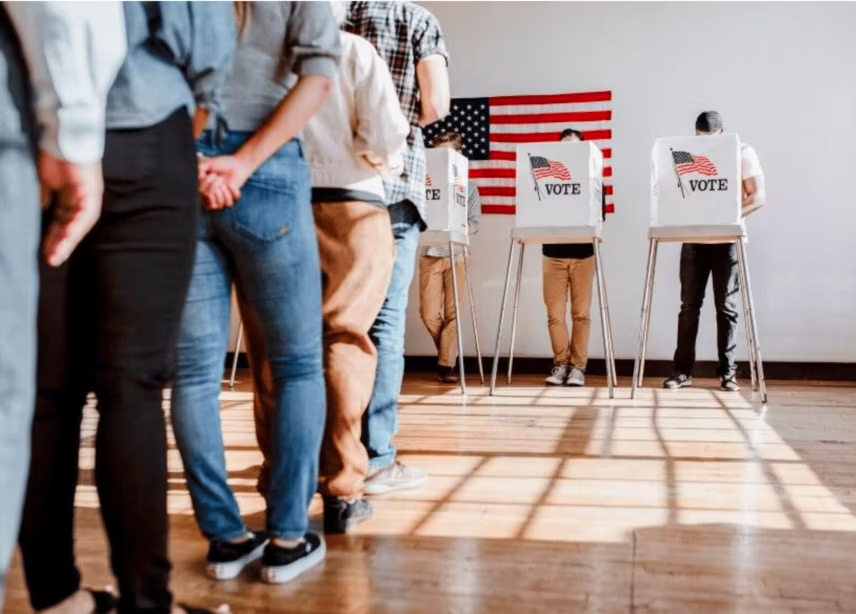
Moreover, another indicator important to companies and investors' perception of the markets – customer and employee sentiments – signals democracy's growing importance. The Civic Responsibility Project poll in 2022 found 82% of Americans would favor companies supporting voting access (including 70% of Republicans), 61% would consider buying from firms speaking out against restrictive voting laws, and 88% overwhelmingly backed paid time off for Election Day voting.[9] A similar survey conducted by JUST Capital before the 2020 election found that 69% of Americans believe that companies should offer paid time off to vote.[10] This growing customer sentiment from pre-election to post-election indicates the weight Americans are placing on the right to vote and democracy.
To further address the business-oriented perspective, studies show that broad representation in an electorate may lead to greater economic growth. The observed effect is significant: by one analysis, increases in civil liberties have corresponded with an increase of 1.3% in GDP per capita over a period of five years.[11]
Given these factors, the business community has a crucial interest in weighing rising political risks and actively championing democratic principles. In doing so, companies not only align with consumer and employee expectations but also contribute to the enablement of a stable economic environment, and investors can mitigate investment risks. Most importantly, the business community fulfills its role in safeguarding the fundamental rights that underpin our society, which benefits us all.
Trillium's Advocacy for Democracy
In this section, we offer examples of investor engagement and actions that Trillium has taken over our 40-year history. This is not an exhaustive list, but investors engaging in democracy advocacy can draw on this list to build their own engagement efforts.
Paid Time Off to Vote
One of the hurdles to participating in democracy is working Americans lack guaranteed time off to vote, often causing a conflict between voters' work schedules and their desire and civic duty to go to the polls. From 2017 through 2022, Trillium piloted a flagship engagement called Paid Time Off to Vote (PTOV), encouraging corporations to offer employees paid time off for civic engagement.
Out of the 66 companies that we engaged in our Large Cap Core strategy in 2022, 45% of the companies offered some form of PTOV. Although most of the companies that offered PTOV were white-collar companies, we also found that companies with manufacturing operations and retail were able to offer PTOV. Leading companies offered at least seven hours paid time off to vote or participate in civic engagement activities, such as volunteering as poll workers.
In the absence of federal law, a variety of stakeholders, including companies, can facilitate higher rates of voter turnout. Giving employees explicit and guaranteed paid time off to vote is one impactful way for employers to encourage participation. Corporate support for voting is cited as a contributing factor in driving voter engagement in recent elections.[12]
Given the importance of corporate support of voter-friendly policies, we asked our portfolio companies questions such as:
- Is there a company-wide policy that provides employees of all categories (full-time, part-time, salaried, and hourly employees) with time off to vote?
- How much time off is provided to vote? If time off is provided, is it paid?
- In states with existing time off laws, does the company do more than comply with state law?
Our advocacy for paid time off to vote resulted in successful corporate policy changes. PNC Financial Services adopted a paid time off to vote for all employees, which impacted 60,000 employees in 21 states. It also joined Time to Vote, a coalition of companies that have pledged to offer employees a work schedule that allows them adequate time to participate in their civic duty.
Similarly, Wabtec adopted a paid time off to vote policy for its 9,500 U.S.-based employees, and Bank of America and Apple increased the amount of paid time off employees were given to vote.
Political Spending & Lobbying
The Citizens United vs. Federal Election Commission ruling in 2010 fundamentally changed interactions between companies, the political process, and democracy. Prior to the ruling, corporations and executives were simply not solicited for donations given the legal restrictions. Under the Citizens United ruling, however, corporations can contribute virtually unlimited amounts of funding to super PACs and dark money organizations.
Companies often contribute with the expectation that the candidates they financially support will advocate for special interests – or grant them access to legislators. This practice creates a corporate dilemma: companies may publicly espouse different values than those of certain interests or causes, or support candidates with stances antithetical to the company's purported values, leading to a potential conflict of interests, reputational damage, or both.
Despite the substantial increase of corporate treasury funds into political candidates' and super PAC* coffers in the years since Citizens United, the value for investors is not clear. Evidence suggests that political spending is unlikely to predictably yield economic benefits to corporations. For example, one study of lobbying and PAC spending by S&P 500 companies between 1998 to 2004 demonstrated that these activities were strongly and negatively related to company value.[13] Moreover, increased reputational risks can arise from political spending, exemplified by the backlash corporations received when their contributions to election deniers were exposed.[14]
Throughout Trillium's advocacy history, political spending and lobbying have been a core focus under our Governance advocacy to encourage corporate accountability and social equality. Since 2003, Trillium has filed over 70 shareholder proposals related to political spending and lobbying transparency. Notable wins include companies such as Chubb, Kansas City Southern, PNC Financial Services, State Street, and Target enhancing their political spending and lobbying transparency following our engagement.
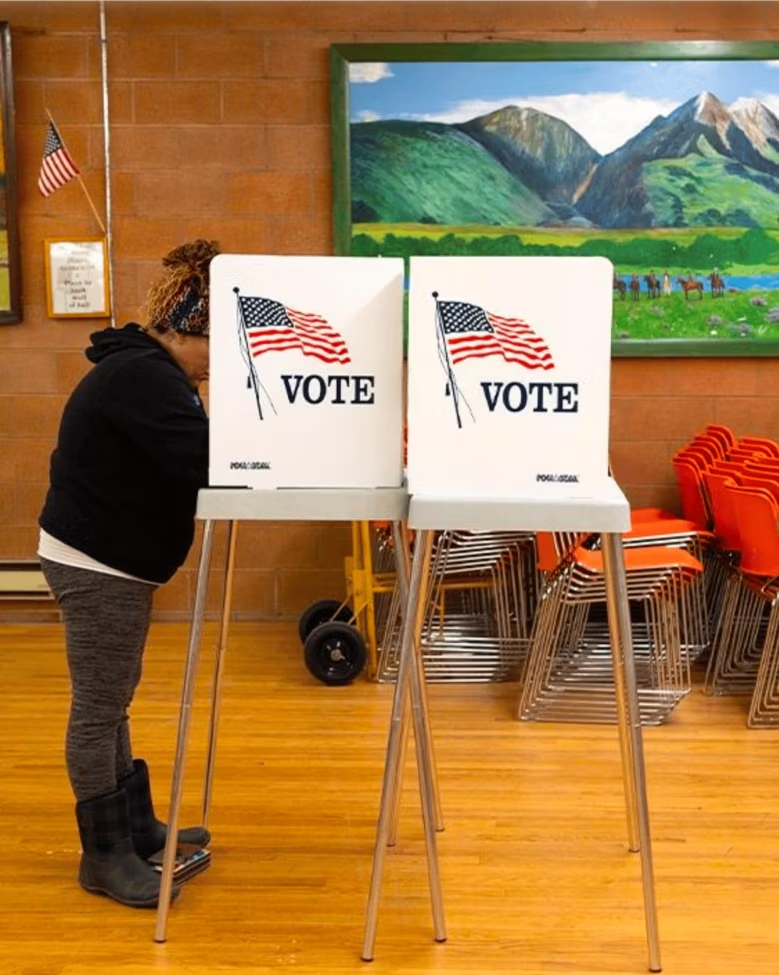
However, the results of long-term investor advocacy focused on various approaches to political contributions and the aftermath of the Citizens United decision have led us to conclude that the environment most conducive to democracy is one in which companies refrain from political contributions. That is, we do not believe corporations are well-equipped to determine which political candidates to support, especially when using shareholders' resources without their input.
Accordingly, while we still support political spending and lobbying disclosures to allow investors to understand where corporate treasury funds flow, we advocate for corporations to abstain from engaging in campaign finance. As such, Trillium has requested portfolio companies to adopt a policy of no political spending or to refrain from contributing to partisan 527s. We filed our inaugural shareholder proposal on this topic at Bank of America in 2012 and again at Verizon in 2022 and 2023 and hope to promote this approach in the years ahead. In addition, Trillium filed a shareholder proposal at Elevance Health for its 2026 proxy that asked the company not to contribute to partisan 527s such as the Democratic Governors Association or the Republican Governors Association.
Looking ahead to the 2026 and 2028 elections
Trillium sent a letter to companies with a meaningful presence in states that are likely to be especially important in the 2026 elections, urging them to strengthen their support for democracy and voting rights ahead of the midterms and the 2028 general election. The letter argues that democratic stability is a material concern for investors and companies because well-functioning markets depend on the rule of law, contractual reliability, fair competition, and respect for fundamental rights. It encourages companies to take practical steps within four areas: supporting employee civic participation through paid time off to vote and voter-registration reminders; refraining from political contributions, especially to partisan 527 organizations, or at minimum strengthening transparency and board oversight; engaging constructively in public policy by supporting voter-registration legislation and pro-democracy coalitions; and using corporate platforms to share voter-registration and know-your-rights information. The letter also emphasized that companies are better positioned to support democratic processes than to attempt to forecast or manage political outcomes, and it asks them to put policies and practices in place well before November 2026 so they are tested, visible, and credible before the 2028 election cycle begins.
Public Policy
Public policy, or the laws, rules, and regulations that govern voting and American democracy, is important to consider when contemplating actions that investors and companies can take. For example, the rules governing access to the ballot box and drawing voting district lines can have an enormous influence on the integrity and health of the democracy. Therefore, exploring how businesses can encourage the promulgation of public policy that enables democracy should be a part of any company or investor approach.
Democratic stability is a material concern for investors and companies because well-functioning markets depend on the rule of law, contractual reliability, fair competition, and respect for fundamental rights.
In 2021, for example, Trillium endorsed a letter by Business for Voting Rights calling on Congress to pass the John Lewis Voting Rights Advancement Act. We believed it was critical to call for voting rights protections at a time when approximately 400 bills restricting voter access were advancing across state legislatures. Voting rights protections have received bipartisan support for over 50 years and make voting safe and accessible to us all, including voters of color who have historically been the targets of discriminatory voting laws. Actively supporting the right to vote is unquestionably the right and just thing to do.
In addition to Trillium supporting the letter, we also encouraged The Hershey Company to join the cause, which resulted in the company's participation alongside 150+ other companies supporting this critical initiative.
Joint Efforts with Pro-Democracy Groups
The complex and multi-stakeholder dynamics inherent in democracy call for a diverse array of entities seeking common ground in identifying problems and solutions. Mass education and awareness are vital to ensuring these various entities understand the opportunities, obstacles, and objectives particular to their circumstances. For this reason, Trillium believes field-building efforts within the business community are important, and we continue to evaluate the unique opportunities we have as investors to encourage constructive discourse and actions for democracy.
As such, we seek opportunities to engage with like-minded companies and groups by participating in organizations such as Business for America (BFA), a non-partisan coalition of business leaders and companies uniting to improve American civic health and help support policies and practices conducive to political stability. Through BFA, we have contributed to roundtable discussions regarding corporate civic leadership, voting rights, and non-partisan reforms – all to understand how the business community could better support civic engagement and democracy.
Trillium has also been a long-time corporate sponsor of American Promise, a cross-partisan organization seeking a constitutional solution to limit the flow of unregulated money into the U.S. political system. As a member of American Promise's Advisory Council, Trillium's former CEO, Matt Patsky, has sought to provide the investors' case for campaign finance reform.
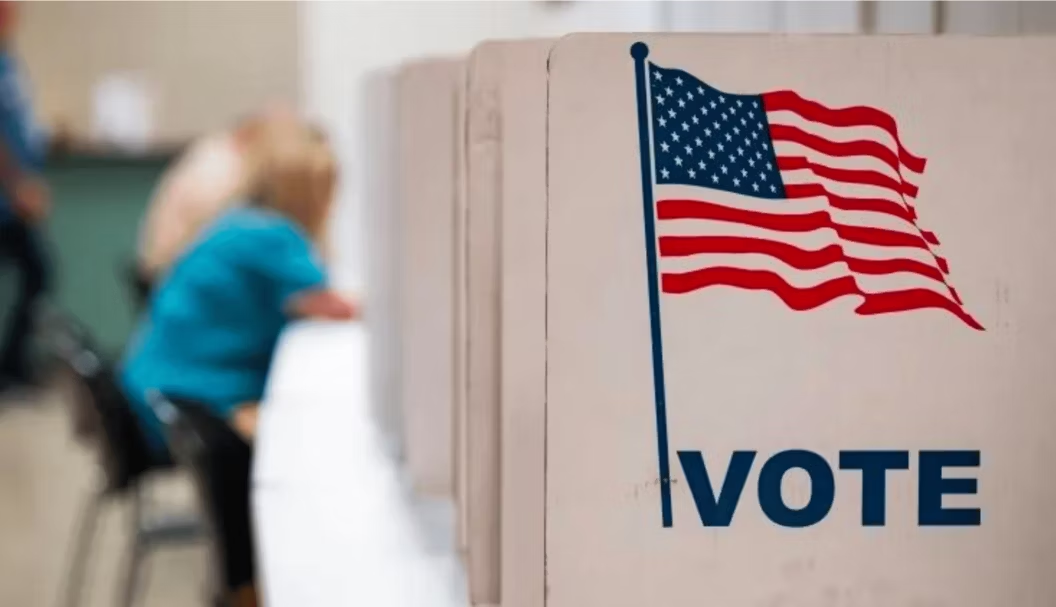
Lastly, we believe it is also important to ensure that we are aligned with democratic principles at the firm level. To that end, we are a proud signatory of Time to Vote, a coalition of over 2,000 companies that have pledged to provide employees with flexible work schedules and paid time off to vote. /image
A Framework for Evaluating Corporate Support of Democracy
Our advocacy for democracy and conversations with companies, investors, and democracy experts have led us to believe that corporate support for democracy, voting rights, and civic engagement takes on several forms. While there is no one-size-fits-all solution, common indicators are present at the companies most supportive of democracy.
Based on our engagements and learnings, we have developed a framework which investors can use to evaluate a company's support for democracy and civic engagement and conduct engagements. Companies can use this framework to evaluate where there may be opportunities to further support democracy.
Citations
1. Buchanan, Naomi. 2023. "CEOs Say Political Uncertainty Poses Greatest Risk to Business Growth." Investopedia. October 7, 2023. https://www.investopedia.com/political-instability-tops-ceos-future-fears-survey-finds-8348594 and https://statesuniteddemocracy.org/wp-content/uploads/2023/07/THE-FINANCIAL.pdf
2. https://www.wtwco.com/en-us/insights/2026/05/political-risk-survey-report-2026
3. https://www.ey.com/en_gl/ceo/ceo-outlook-global-report
4. Mosley, Layna. 2023. "The Financial and Economic Dangers of Democratic Backsliding." July 2023. https://statesuniteddemocracy.org/wp-content/uploads/2023/07/THE-FINANCIAL.pdf
5. Ibid.
6. Ibid.
7. Tedeschi, Ernie. 2024. "Political Risks to the U.S. Safe Harbor Premium." Yale.edu. May 2024. https://budgetlab.yale.edu/sites/default/files/2024-05/The%20Budget%20Lab%20Safe%20Harbor%20Analysis%202024_0.pdf
8. Ibid.
9. Global Strategy Group & Civil Responsibility Project. 2021. "Americans See Role for Companies in Securing Voting Access." April 2021. Website.
10. "As the 2020 Election Approaches, Americans Say Companies Have a Role to Play in Upholding and Protecting Democracy." n.d. JUST Capital. Accessed May 21, 2024. https://justcapital.com/reports/americans-want-companies-to-help-uphold-democracy/
11. Hogg, Annabel Lee, and Robin Hodess. 2018. "The Business Case for Protecting Civic Rights." October 2018. https://bteam.org/assets/reports/The-Business-Case-for-Protecting-Civic-Rights.pdf
12. Spillane, Ashley, and Sofia Gross. 2019. "Why and How Companies Invest in Get-out-the-Vote Efforts." Harvard Business Review, August 6, 2019. https://hbr.org/2019/08/why-and-how-companies-invest-in-get-out-the-vote-efforts
13. A super PAC is an independent political action committee (PAC) that is permitted to receive unlimited contributions from individuals, corporations, labor unions, and other PACs to finance independent political activities and expenditures. Super PACs are not permitted to make contributions to federal candidates or committees, but are allowed to contribute unlimited funds to advocate for or against political candidates. Lund, Dorothy, and Leo Strine. 2022. "Corporate Political Spending Is Bad Business." Harvard Business Review, January 1, 2022. https://hbr.org/2022/01/corporate-political-spending-is-bad-business
14. Piper, Jessica, and Zach Montellaro. 2023. "Corporations Gave $10M to Election Objectors after Pledging to Cut Them Off." Politico.com. January 6, 2023. https://www.politico.com/news/2023/01/06/corporations-election-objectors-donations-00076668
Important Information: This content is for informational and educational purposes only and not intended as investment advice or a recommendation to buy or sell any security.
About Trillium Asset Management
Trillium Asset Management offers investment strategies and services that advance humankind towards a global sustainable economy, a just society, and a better world. For over 40 years, the firm has been at the forefront of ESG thought leadership and draws from decades of experience focused exclusively on responsible investing. Trillium uses a holistic, fully integrated fundamental investment process to uncover compelling long term investment opportunities. Devoted to aligning stakeholders' values and objectives, Trillium combines impactful investment solutions with active ownership. The firm delivers equity, fixed income, and alternative investments to institutions, intermediaries, high net worth individuals, and other charitable and non-profit organizations with the goal to provide positive impact, long-term value, and 'social dividends'™.
Contact Information
ContactUs@trilliuminvest.com
US: +1 (800) 548-5684
Perpetual Group and Trillium Asset Management, LLC are affiliates under Perpetual Ltd. Australia.
Please note the email provided is for general inquiry purposes only and personal information should not be provided.